 Feng shui at Olaie
Read the home, not just the listing.
Your broker is trained in feng shui. Every buyer and seller plan includes a feng shui report* of the land, facing and layout, in plain language. Max and Listing Max add an in-person review with your broker.
Whether you use feng shui is your choice. The brokerage work is the same either way. About feng shui reports*
Your choice
Believe in feng shui or not. Your choice.
Feng shui is one more way to look at a home. It never replaces market analysis, and we never press a belief you don't share.

The market, first
Pricing, strategy, negotiation and transaction coordination, done the same careful way for every client.

Feng shui, when you want it
If it matters to you, your plan's feng shui report* covers each home's land, facing and layout before you decide. Max and Listing Max add an in-person review with your broker.

Your decision
You decide what counts. We help you see the home clearly; the choice stays yours.
“Good service isn't asking every client to share one belief. It's understanding what you need, doing the professional work well, and helping you make the decision that fits you.”
What a reading looks at
Four ways to read a home.
The classical order is the land first, the compass second. A reading* combines public assessor records, open mapping data and details you confirm, then looks through four lenses.

Form School (形勢)
The land around the home: slope, water, roads and what stands behind and in front.

Facing and Eight Mansions (八宅)
The direction the home faces, and how the entrance and rooms sit against it.

Flying Stars (玄空飛星)
The home's period chart, built from when it was built and the way it faces.

Five Elements (五行)
How wood, fire, earth, metal and water balance across the home's directions.
Nine palaces
A floor plan, in nine palaces.
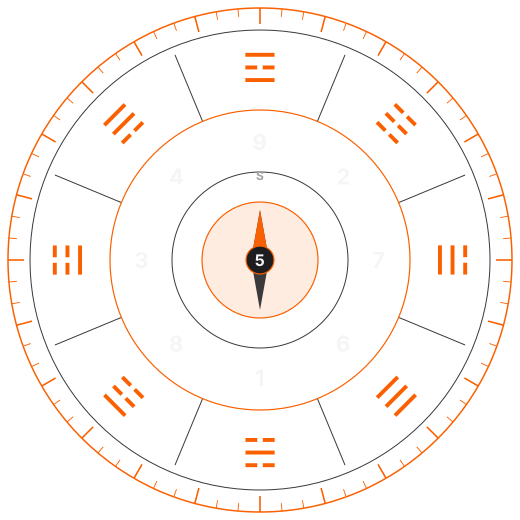
Feng shui divides a home into nine palaces (九宮): eight directions and the center. The eight outer palaces each carry a trigram, and all nine carry an element and a number from the Lo Shu square (洛書). Choose a palace to see what it holds.
Center
The center palace (中宮)
- Element
- Earth (土)
- Lo Shu number
- 5
- Image in nature
- None (the center has no trigram)
The heart of the plan. Tradition favors keeping it open and uncluttered.
Traditional diagrams put south at the top. Each row and column of the Lo Shu square adds up to 15.
Five elements
Five elements, two cycles.
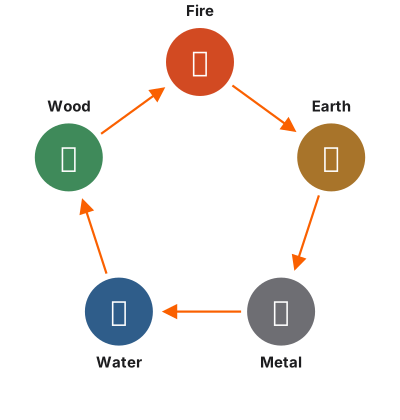
In one cycle each element feeds the next. In the other, each keeps another in check. A reading notes which elements lead in each direction of the home and where the balance tips.
Wood feeds fire, fire makes earth, earth bears metal, metal carries water, and water nourishes wood.
Wind and water
An old idea found in many famous places.
Feng shui means wind and water (風水). The term is traced to the Book of Burial (葬書), traditionally credited to Guo Pu (郭璞), a scholar and feng shui master of China's Eastern Jin dynasty, about 1,700 years ago. Its central idea: qi scatters on the wind and gathers where water holds it.

Beijing: the Forbidden City (紫禁城)
Tradition holds that Jingshan, the hill just north of the palace, was raised from earth dug for the moat, giving the palace the hill-behind setting feng shui favors.

Seoul: Gyeongbokgung (景福宮)
Built in 1395 with Bugaksan rising behind and the Han River ahead to the south, beyond Namsan: the mountain-behind, water-ahead siting (背山臨水) that Korean pungsu shares.

Hong Kong: the HSBC Main Building
Completed in 1985. Feng shui advice is reported to have shaped the angle of its escalators and the open plaza at its base.
Buying and selling
Feng shui, put to practical use.
Buying: see past the photos.
- Is the price fair? Does the location fit your life? Are repairs and holding costs within reach? We start there.
- If feng shui matters to you, your report* covers the land, facing and layout of homes you consider. With Max, your broker reviews them with you in person: what furniture placement can address, and what would take renovation. An inspector or contractor can confirm structure and cost.
- If it doesn't, we focus on what you care about. Feng shui never stands in for market analysis.
Selling: explain the home's strengths.
- Pricing, marketing and staging advice built on the market, the home, your goals and your budget.
- When buyers ask about facing, the entry or where the bedrooms sit, your broker answers with the home's facts, not just "the feng shui is good."
- If feng shui matters to you, your report* covers the land, facing and layout of your home. With Listing Max, your broker reviews it with you in person and suggests feng shui changes before photography.
- If it doesn't, we focus on what buyers care about: condition, presentation and price.
Questions
Feng shui at Olaie, answered.
Do I need to believe in feng shui to work with Olaie?
No. Every client gets the same brokerage work: pricing, strategy, negotiation and coordination. Feng shui is there if you want it.
What is a feng shui reading based on?
Public assessor records, open mapping data, the way the home faces and details you confirm. Readings are produced by DwellSoul, LLC.
Is a reading an appraisal, inspection or prediction?
No. A reading is a traditional perspective on the home. It is not an appraisal, inspection or prediction, and it does not replace a home inspection.
Who sees my birth details?
The household match is optional. Birth details are entered directly with DwellSoul for the calculation, under DwellSoul's privacy policy, and are not shared with Olaie or your broker.
Which plans include an in-person feng shui review?
Max for buyers and Listing Max for sellers. Every other buyer and seller plan includes feng shui reports from DwellSoul.
Interested in a home?
Start with its feng shui reading, or talk it through with your broker.